Setas rellenas
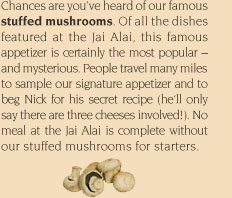
Large mushroom caps stuffed with a secret Basque cheese blend and baked in a wine sauce. The dish people drove out of their way for.
La Cocina Vasca
A Basque menu is a set of habits as much as a list of dishes: shellfish cooked hard and fast in olive oil and garlic, rice coloured with saffron, sauces carried by sherry and Jerez wine, and a long table that nobody is in a hurry to leave.
Jai-Alai Restaurant closed permanently after the fire of September 2023. This page explains the dishes as the restaurant served them; the full menu with prices is here.
Start here
Chances are you have heard of the stuffed mushrooms. Of all the dishes featured at the Jai Alai, the famous appetizer was certainly the most popular — and the most mysterious. People travelled many miles to sample it, and to beg Nick for his secret recipe. He would only ever say that three cheeses were involved.
What the menu card confirms is the method: large mushroom caps stuffed with a secret Basque cheese blend and baked in a wine sauce, served as setas rellenas at $13.00. No meal at the Jai Alai was considered complete without them for starters.
Large mushroom caps stuffed with a secret Basque cheese blend and baked in a wine sauce. The dish people drove out of their way for.
The classic Basque paella, named for Bizkaia: fresh lobster, shrimp, scallops, clams, mussels, squid, chicken and chorizo over saffron rice, for two or more.
Red or white, made in house with no sugar added, sold by the half pitcher and the full pitcher. The reviewer from dover_nj.com called it superb either way.
Two versions of the same idea: a casserole of fresh lobster, shrimp, scallops, clams, mussels and squid, served for two or more at $25.00 per person. The salsa roja was laced with brandy; the salsa verde was built on garlic, parsley and olive oil. Both are pure Basque coast cooking — the fish is the point, the sauce is only there to carry it.
The test of a Spanish kitchen. Juicy medium shrimp in a slow-roasted garlic extra-virgin olive oil sauce, $15.00. The technique is in the word ajillo: garlic cooked slowly in oil until it is sweet rather than sharp, with the shrimp added at the end so they stay firm.
A casserole of richly flavoured garlic soup topped with a poached egg on a raft of toast, $6.00. Garlic soup is peasant food from Castile and León that settled comfortably into Basque kitchens — bread, paprika, garlic and broth, made substantial with an egg.
A trimmed N.Y. sirloin, Basque style, broiled to specification, $26.00. In Gipuzkoa the great ribeye is treated as a subject in its own right: thick-cut, salted heavily, grilled hard and served rare, with nothing on the plate to distract from the beef.
The dish the kitchen named for itself, in both veal and chicken. Medallions enclosed in egg batter, sautéed in extra-virgin olive oil, then combined with sautéed onions, mushrooms, pimento, artichoke hearts and white asparagus. This is the Basque albardado technique — a light egg-and-flour coat that protects the meat and thickens the pan sauce — taken as far as the pantry allows.
Arugula, watercress, Belgian endive, romaine, tomatoes and red onions, tossed with walnut oil, extra-virgin olive oil, grape-seed oil, balsamic vinegar and Dijon mustard, and topped with brie cheese, $12.00. Not Basque in origin, but very much in the spirit of a northern Spanish table: bitter greens, good oil, one rich element.
Broiled half chicken with fresh garlic and extra-virgin olive oil at $18.00, alongside a broiled filet mignon at $28.00 and roast duckling in a mandarin-orange Grand Marnier sauce at $25.00. The grill was never an afterthought.
Six ingredients explain most of the menu. They are also the fastest way to cook Basque food at home.
The house poured sangria, red or white, with no sugar added, and wine by the glass and bottle. To match the cooking at home, look for a Txakoli from Getaria for the shellfish — light, faintly sparkling, poured from a height — and a Rioja Reserva or a Navarra for the grilled meats and the duck.