
The name on the door
The Basques: Europe's oldest surviving people
The Basque people are the most ancient surviving ethnic group in Western Europe. Their homeland runs along the Atlantic coast from Bilbao, Spain, to the Landes of Biarritz, France — and their language is unrelated to any other language on earth.
This page was originally published as a single picture on the restaurant's website. The text has now been restored as real, searchable text, with the restaurant's own wording kept wherever possible and the history and food notes expanded below.
Who the Basques are
The Basque people comprise the most ancient surviving ethnic group in Western Europe. Their homeland, which Basques call Euskal Herria — literally “the land of the Basque language” — extends along the coast from Bilbao, Spain, to the Landes de Biarritz in France. There are over five million Basques living in this region, and about 85 percent of them live on the Spanish side of the border.
The Spanish Basque Country is made up of three provinces and one chartered community: Bizkaia, Gipuzkoa, Araba and Navarra. The northern, French side — Iparralde, the “north country” — takes in Lapurdi, Nafarroa Beherea and Zuberoa, with Bayonne as its largest city. Bilbao and San Sebastián, the two great Basque eating cities, sit in Bizkaia and Gipuzkoa respectively.
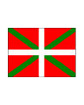
Those seven territories are the zazpiak bat — “the seven in one” — and the flag on the right is the emblem most Basques rally around. It was designed in Bilbao in 1894 and has since been adopted well beyond the Basque Country as a sign of the region's food and its festivals.
Euskera: a language with no relatives
One of the most distinguishing features of the Basque people is their language, Euskera. It is unrelated to the other European languages, or — so far as is known — to any other language in the world. It predates the arrival of Latin and of the Romance languages that grew out of it, and it has survived in the same corner of the Pyrenees and the Bay of Biscay ever since.
A few words carry more than a little of the restaurant's world:
- Kaixo — hello.
- Eskerrik asko — thank you.
- On egin — “eat well”, said to someone about to sit down to a meal.
- Jai alai — merry festival.
- Txakoli — the light, slightly sparkling Basque white wine poured from a height.
- Pintxos — the small snacks that cover the bars of San Sebastián and Bilbao.
- Bacalao — salt cod, the fish that built Basque trade and Basque cooking.
The culinary high ground of Spain
Most Spaniards and Iberian food aficionados will advise the uninitiated to do business in Barcelona, pull political strings in Madrid, and follow the jet set in Marbella. But to savour the country's best cuisine, they will tell you to go to the Basque region. If Spain is blessed with a rich and varied gastronomic landscape, then the Basques occupy the indisputable culinary high ground.
That reputation is built on a handful of things: an obsessive interest in the product, whether it is salt cod, a scallop or a pepper; the cooking societies called txoko, where friends cook for one another; and the cider houses and grill rooms where a thick-cut ribeye is treated as a serious subject. It is also built on olive oil, garlic and the sherry, brandy and Jerez wines that carry Basque sauces.
See how that tradition reached the Jai Alai's kitchen →
Jai alai, the game the restaurant was named for
Jai alai means “merry festival” in Euskera, and it is also the name of the Basque ball game played with a long, curved wicker basket called a cesta. Players catch the ball in the basket and hurl it against the wall of a court called a frontón, at speeds that make it the fastest ball game in the world.
The game travelled from the Basque Country to Cuba, Mexico, the Philippines and to Florida, Connecticut and Rhode Island, which is how a Basque restaurant in Morris County, New Jersey, came to carry a name that most of its neighbours knew first as a sports arena.
What this meant at the table
At the Jai Alai, this heritage showed up in specific ways: seafood casseroles built for sharing, rice coloured with saffron rather than cream, egg-battered escalopes and albardados, garlic handled gently, and a sangria made in house with no sugar added. Nothing was improvised. The kitchen cooked to order and finished in Spanish extra-virgin olive oil.